7. Active Learning Loop
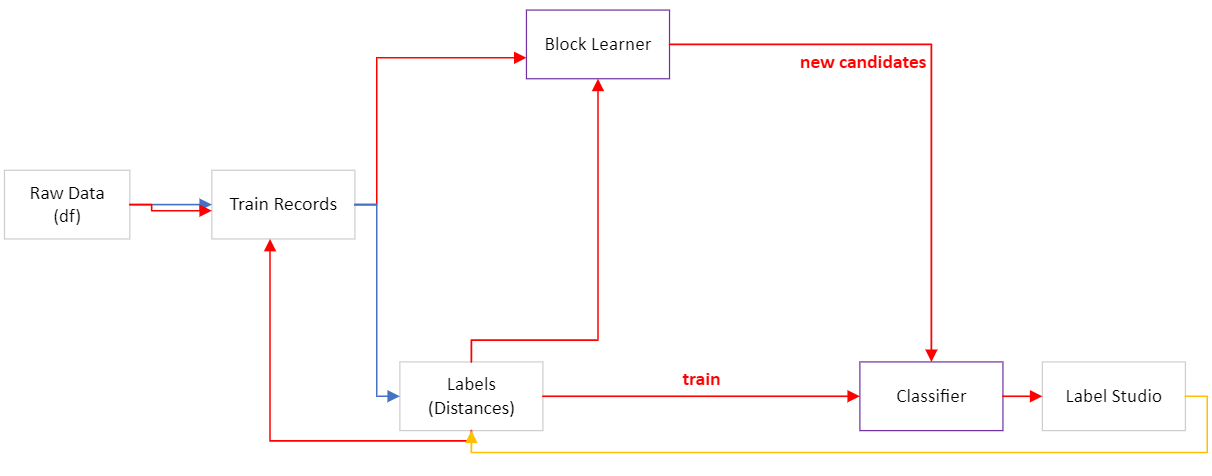
In the diagram below, the arrows’ colors represent the stage of the loop:
blue: initialization
red: active learning
yellow represents the start of a new active learning loop
The image below shows initialization steps in blue and the active learning loop
in red.
7.1. Initialization and First Pass
The initialization steps represent the sampling and fake labelled data construction discussed earlier. The train data and fake labelled data are used as inputs in the block learner, which evaluates block conjunctions based on reduction ratio, positive coverage, and negative coverage.
The block learner applies the best conjunctions to generate comparison pairs.
The classifier is trained using the labelled data. The comparison pairs from the block learner represents the test set and the classifier applies uncertainty sampling on this test set to generate candidates for human review.
We conduct the human review in label-studio. When a condition is met ( e.g. fewer than 5 tasks remaining in label-studio), fastAPI generates new samples, signalling the end of an active learning loop and triggering a new one (the yellow arrow).
7.2. New Active Learning Loop
At the start of a new active learning loop, two events occur:
update
trainwith new labelsdelete unlabelled records from
trainand pull a new sample fromdf
And then we repeat: the train data and labelled data (which now includes the original fake-construction of labelled data AND outputs from label-studio) are used as inputs in the block learner. The best conjunctions are evaluated once again, then applied to generate comparison pairs. The classifier is updated with new labels and applies uncertainty sampling on this fresh batch of comparison pairs. A human reviews on label-studio.
This cycle repeats indefinitely and user can make predictions on the full data at any point. (Note that up to this point, we have only been working with repeated samples from the raw data. Labels persist through active learning loops but train data is resampled at the start of each loop.)
7.3. Predictions on Full Data
To make comparisons on the full data, we apply the trained block learner and classifier directly on the full data:
